Connection and Community: Reflections from my first MIE Conference
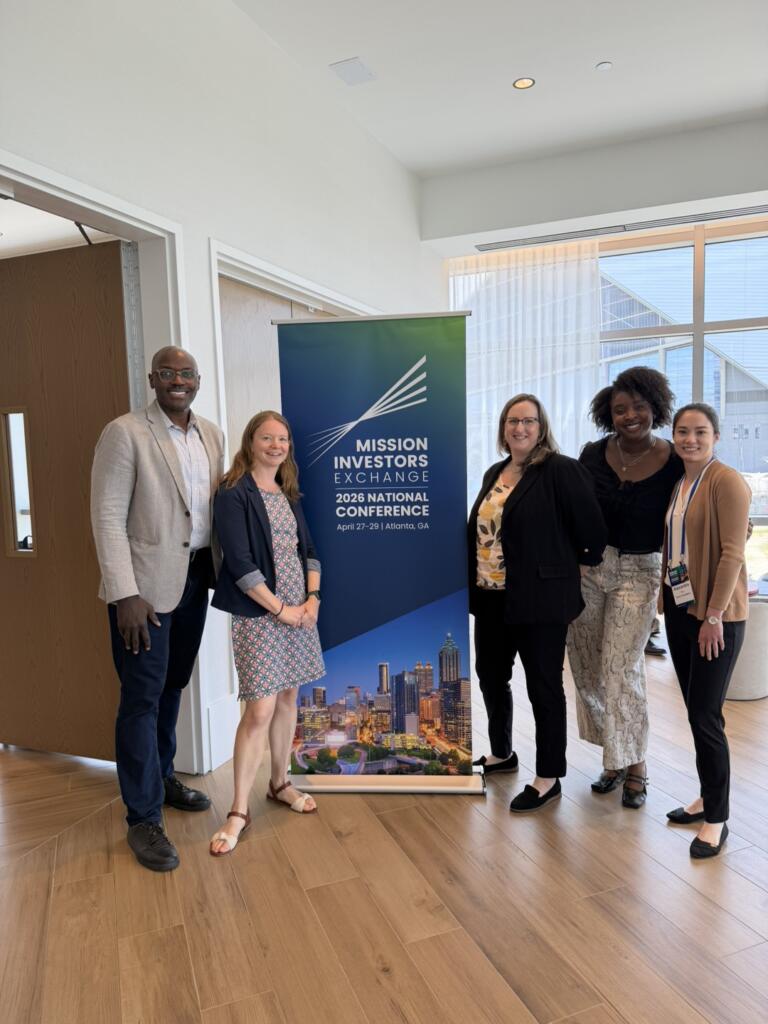
I attended my first Mission Investors Exchange (MIE) national conference last month. While new to me, Heron has been actively engaged in MIE since its founding. However, this convening felt especially more momentous, as Heron is in the early stages of a new strategic direction. As I complete my first year as Senior Director of Investments, I wanted to hear what the field was thinking and building toward to help inform how we might innovate on our own strategy. What I didn’t fully anticipate was how much the experience would remind me of why this work matters in the first place.
The thing that hit me first wasn’t a panel or a keynote—it was the room itself. It was packed! Even as a first timer, I could feel a strong sense of connection among the people there. From the keynotes to the conversations I overheard in passing, there was an acknowledgment of the scale of the challenges ahead and the weight of what remains to be done. Impact investing has made significant progress since the early days when Heron and other original mission investors began walking down this path. And still, the challenges we are trying to address presently whether that be access to quality education, affordable housing, healthcare, or the basic ingredients of a decent standard of living, haven’t waited for the field to catch up. The gap between what has been accomplished and what is still needed continues to widen. It’s a sobering reality.
But the connection among impact investors, as meaningful as it was to feel, is not the most important kind. The most important connection is to the people and places we are dedicated to serving. That reminder hit home for me from some of the community focused breakout sessions. As Heron moves into our new chapter, a lot is changing. Our investment strategy is evolving. Our portfolio is being aligned to serve a more focused mission. What isn’t changing is our commitment to community. If anything, the conference sharpened my sense of urgency around this very premise.
Several themes from the conference are still sitting with me:
Capital and democracy are not separate conversations.
This came up repeatedly and in ways I didn’t anticipate. When power consolidates in markets, it makes transparency harder. It makes shareholder accountability harder. It makes the job of mission-aligned investors harder. One speaker framed it straight-up: democracy, the economy, and the environment are interconnected systems, and impact investing should be fortifying all three, not just one. That’s real talk that raises a hard question for every foundation: What are the economic conditions that make democratic participation possible, and is your portfolio working for or against those conditions? There was also an honest acknowledgment that the separation of markets from philanthropy, the old assumption that the investment portfolio lives in one world and the grants program lives in another, is counterproductive and a missed opportunity. I overheard someone say: Foundations exist to advance their missions, not to park assets in index funds and hoard wealth. That’s a line I will be borrowing.
Know what you own. Then do something about it.
Heron has long held that foundations have an obligation to know what they own. It was heartening to hear conversations about how shareholder activism is being leveraged as tool of mission alignment, and the principle that anchored it was simple: It starts with understanding what you own. Not just the ticker or the fund name, but what is actually in the portfolio, who is running those companies, and what are they doing in—and in some cases—to communities? AI is increasingly being used to help foundations answer that question at scale, and at least one organization shared that the work led them down unexpected paths of engagement they wouldn’t have found otherwise.
The point wasn’t that every foundation should be filing shareholder resolutions or preparing for litigation but rather that ownership is not passive. You have a voice as a shareholder, and being present and asking questions is itself a form of accountability. That’s not separate from fiduciary duty. Done thoughtfully, it upholds it.
Rural investing is slow, messy, and worth it.
There was a workshop dedicated to rural investing, and I came away with a deepened appreciation for both the complexity and the opportunity. Real talk—this work is not fast, and it is not pristine. You have to be in it for the long haul. You have to show up as an investor alongside communities, not as a foundation handing something down.
A case study involving a complex tribal investment stood out. The lesson wasn’t about the deal mechanics. It was about posture. Coming to the table as a co-investor, accepting real risk, and trusting communities as partners rather than recipients is what made the work meaningful. For Heron, with our focus on the Deep South, Appalachia, Southern Border, and Native communities, that perspective is exactly right.
This is not a moment to shrink.
I’d say MIE had a clear call to action. In unpredictable times, you don’t pull back. You stay anchored in your values, and you make bold moves. You don’t separate yourself from what others are experiencing. You talk to people. You visit the places at the heart of what drives this work in the first place. You stay connected.
“The cavalry isn’t coming. We are the cavalry.” – MIE attendee
I felt that one. In a room full of impact investors, foundation leaders, and practitioners no one should be waiting to take action. The work of building a more equitable economy is ours to do, and the urgency of this moment demands more from us, not less. Someone also offered this: fight for the democracy we have today so that we can shape the democracy we need for the future. The investment portfolio is one of the tools we must use.
Heron is in the middle of a real transition. We are making hard decisions about capital allocation and trying to do it in a way that is faithful to the communities we exist to serve. MIE reminded me that we are not doing this alone, and that the field, for all its challenges, is full of people who are serious about the same questions we are asking.
That connection matters. It’s worth protecting. And it’s worth bringing back home to the communities we work for, which is ultimately where all of it has to land.
1 Comment
Thanks Chris for your excellent observations. I really appreciate how you underscore the relationship of democracy and economy. I think more people in philanthropy need to pay attention to the connections between these two as well as the environment. Unfortunately in the Transformative 25 network of impact first community rooted funds I facilitate, the funds report that many foundations say they need to attend to the crisis in our democracy and thus cannot fund these incredibly effective initiatives that integrate grant and investment capital. What we fail to imagine in philanthropy is that quality jobs and economic opportunity for the unbanked and underbanked is critical to creating pathways for an economy that serves us all and get show us a pathway toward a more human centered economy. We look forward to Heron’s continued leadership in the files of integrated capital. Learn more from these funds at http://www.transformative25.org